---
title: Chime | LinkedIn Live Recap Feb '26
description: Recap of Doximity and Chime’s LinkedIn Live on the future of healthcare, AI, clinician burnout, and restoring humanity to care by 2040.
image: https://doximity.hospitalsolutions.com/hubfs/LI%20Chime%20Recap%20Image.png
---
- [Skip to main content](https://doximity.hospitalsolutions.com/resource-hub/chime-linkedin-live-recap#wrapper)
[Resource Hub](https://doximity.hospitalsolutions.com/resource-hub) **Chime | LinkedIn Live Recap Feb '26**
Share this
[Telehealth](https://doximity.hospitalsolutions.com/resource-hub?topic=telehealth)
4 min read
# Chime | LinkedIn Live Recap Feb '26
[Click Here ](https://www.linkedin.com/events/7427360198123573248/)to Watch the LinkedIn Live Now
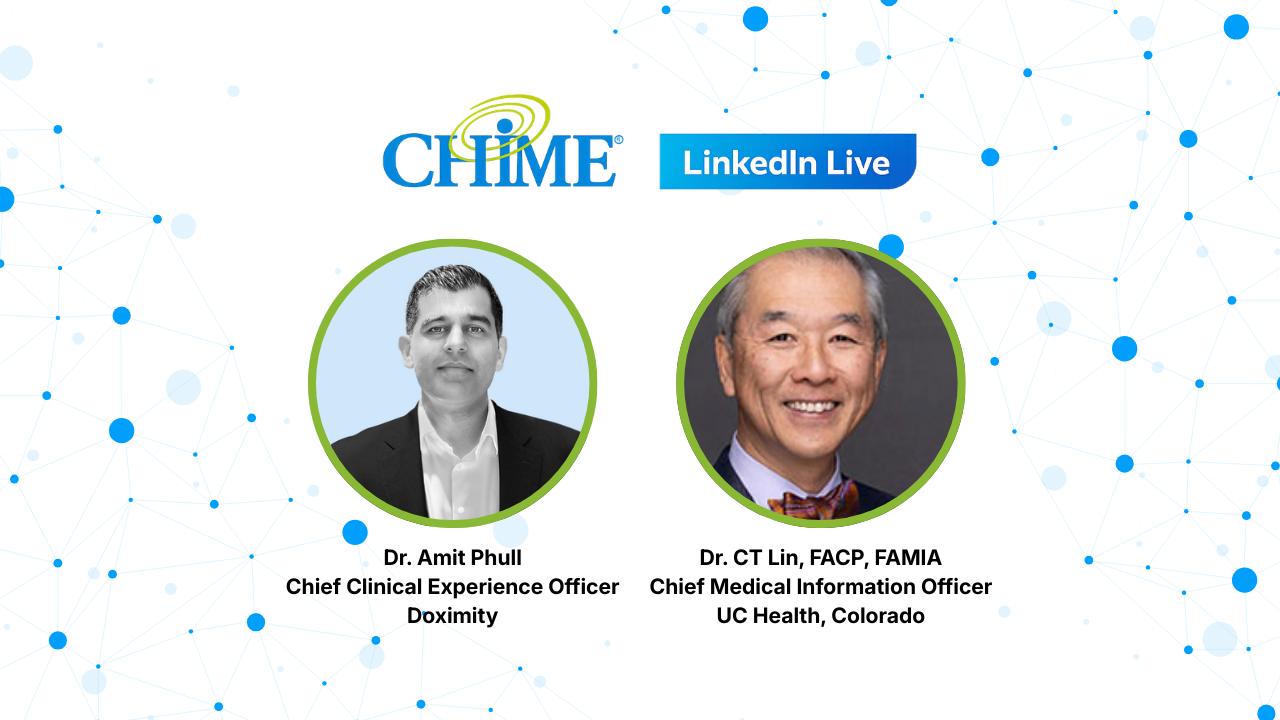
Last month, Doximity partnered with Chime for an engaging [LinkedIn Live discussion](https://www.linkedin.com/events/7427360198123573248/) that brought together two visionary healthcare leaders to explore what healthcare transformation will look like by 2040. Dr. Amit Phull, Doximity's Chief Clinical Experience Officer, joined Dr. CT Lin, Chief Medical Information Officer at UC Health-Colorado, for an unfiltered conversation about AI, clinician burnout, and the future of care delivery.
**Key Highlights**
*The Tension Between Exhaustion and Innovation*
Both leaders acknowledged the weight healthcare professionals are carrying today: burnout, fragmentation, and overwhelming complexity. Yet they agreed we're simultaneously standing at the greatest intersection of opportunity to reinvent care. As Dr. Lin put it jest, he's been known as "the guy who ruined healthcare" for introducing computers into exam rooms, but now, with ambient AI technology, colleagues are telling him, "You've really changed my life. I can get home to dinner with my family for a change."
*Restoring Humanity Through Technology*
Rather than viewing AI as replacing clinicians, both speakers emphasized its potential to *restore* what brought them to medicine in the first place. Dr. Phull noted:
*"We are simultaneously exhausted, but also on the brink of something quite significant. I would modify it, though, and not really view it as reinventing healthcare, but rather potentially restoring some elements of it that we kind of lost along the way."*
The conversation revealed how ambient listening technology is giving doctors their eye contact back, something many didn't realize they'd lost until patients started commenting on the difference.
*The AI Greek Chorus: Fighting Complacency*
Dr. Lin introduced a fascinating concept: rather than relying on a single AI assistant that could lead to complacency, imagine multiple AI "voices" offering conflicting perspectives—a patient advocate, a quality expert, a wise counselor—forcing clinicians to remain the captain of the ship and think critically about decisions.
Dr. Phull added his perspective on maintaining clinical autonomy:
*"We need to be very mindful of that cost-benefit. The appropriate amount of friction so as to drive growth and ownership and agency and autonomy—all of these core values that are from our seat, very just root to being a clinician. If you sacrifice those, then you're kind of redefining what the actual role you play in all of this is."*
*Closed-Loop Communication for the Future*
Both leaders emphasized that preparing for 2040 isn't about predicting every innovation—it's about maintaining open communication between all stakeholders. Dr. Phull drew parallels to critical care scenarios: "We need closed-loop communication where we're all aligned on the objective, acknowledging that we are operating on the same team towards the same objective."
### **The Bottom Line**
Healthcare is heavy, but we're not stuck—we're designing. The conversation left us with this powerful reminder: transformation doesn't happen in a single live stream. It happens in the follow-up conversations, in the decisions we make today about how technology serves humanity rather than replaces it.
*Special thanks to Dr. Amit Phull and Dr. CT Lin for their candor, and to Chime for hosting this important dialogue. And yes, Dr. Lin closed the session with an original song parody about ChatGPT set to "Sweet Caroline"—because why not end a conversation about the future of healthcare with a little joy?*
## If you’d like to watch the recap, you can find the recording [here](https://www.linkedin.com/events/7427360198123573248/).
## You might also be interested in...
---
## Stay up to date
Get the latest insights to help you reach your organization's strategic goals – on topics from brand awareness, patient acquisition, and revenue generation to on-call scheduling, telehealth, and AI.
[By clicking Sign Up you're confirming that you agree with our Terms and Conditions.](https://doximity.hospitalsolutions.com/terms)
Link Copied!
## Get to know us
## Engage with us
© Doximity 2026
```json
{
"@context" : "https://schema.org",
"@type" : "BlogPosting",
"author" : {
"@type" : "Person",
"name" : "Lindsey Alford",
"url" : "https://doximity.hospitalsolutions.com/resource-hub/author/lindsey-alford"
},
"dateModified" : "2026-03-04T20:56:12.944Z",
"datePublished" : "2026-03-03T17:22:42.000Z",
"headline" : "Chime | LinkedIn Live Recap Feb '26",
"image" : [ "https://doximity.hospitalsolutions.com/hubfs/LI%20Chime%20Recap%20Image.png" ],
"mainEntityOfPage" : {
"@id" : "https://doximity.hospitalsolutions.com/resource-hub/chime-linkedin-live-recap",
"@type" : "WebPage"
},
"publisher" : {
"@type" : "Organization",
"logo" : {
"@type" : "ImageObject",
"url" : "https://doximity.hospitalsolutions.com/hubfs/Type=doximity%20(7).png"
},
"name" : "Doximity"
}
}
```